Showing posts with label ruffles. Show all posts

Friday, 12 September 2014

DIY Lolita: Mary Magdalene inspired/replica dress UPDATED

I have always loved Mary Magdalene  dresses. They have a really simple design that I love and a little while ago I completely fell in love with this style. Unfortunately, Mary Magdalene sizes are small even for Japanese lolitas, so I figured I'd try and make one for myself. DISCLAIMER: In general I'm not a fan of replicas and certainly not a fan of replica dresses being sold when they take business away from the original desiner. The reason I've made this for my own personal use is because I know I will never be in a position to wear on of Mary Magdalene's dresses for myself, and I want to use this simplistic cut for my own work. I ideally would like to get to a skill level where I could simply be "inspired" by this design, but at present I feel the finished article style is too close to the original for me NOT to call it a replica.

Going for something like this
Fabric and trim (didn't end up using the rickrack)
Firstly I used Anny's Princess Seamed Bodice Generator (available here) to make the bodice because I find usual princess seamed patterns don't really accommodate my shape. However, the generator only really helps you make the bodice, and doesn't tell you anything above the top bust, so I drew it out, stitched it together, then lay some calico under the bodice and drew in where I wanted the arm/shoulder parts to be.


I tried it on, and it was WAY too big. so I tailored it at the sides and front, and started laying out the new pattern on the fabric. To start I cut out the lining just to check I liked the shape, then laid the lining piece very carefully over the fabric, as I really wanted to make sure the stripes lined up correctly on the finished dress.
Lining on mannequin with a petticoat for shape

 I used a tutorial on Riley Blake Designs to make the scalloped edging on the neck and on the hems. The easiest way to do this is to cut a facing out of the same fabric, mark the scallops, stitch them together and cut them out as close to the stitching as you dare (about 0.5cm)

Also remember to measure the hem and divide evenly by the number of scallops you want. If I remember correctly there were 10 scallops on the front and 6 on the back.


 Once you've cut the excess flip them right way out and PRESS! This is incredibly time consuming but totally worth it.


The sleeves were a very simple capped sleeve tutorial which I sadly miscalculated my measurements, so while the sleeves fit they are a little bit small. Then I added the cream crochet trim to the neckline, sleeve ends and scalloped hem.


 All that was left was to hand gather (why do I do this to myself) 7 strips of 150mm dark green fabric to make the ruffles on the bottom. I didn't quite like the way it sat at the back, so I added some of the dark green fabric to make a sash and break up the shape a little.

Final touch was some pearls, and a straw hat and as many cream/pink/white roses as I could find (which was 7, as well as a little rose I made from scrap fabric)
Of course I blinked as the photo was taken!


Sunday, 15 September 2013

DIY Lolita dress: The blue dress 2.0, the nint dress

A good few months ago I started work on a replica of Krad Lanrete's Le Chuchotis de L'été, an it didn't go so well (see here).  The biggest problem was I didn't like the weight of the fabric, and recently came across some mint green chiffon which was much heavier. I decided to scrap almost the whole thing and painstakingly unpicked everything so all that was left was the lining. BEGIN AGAIN.

The Dress Body
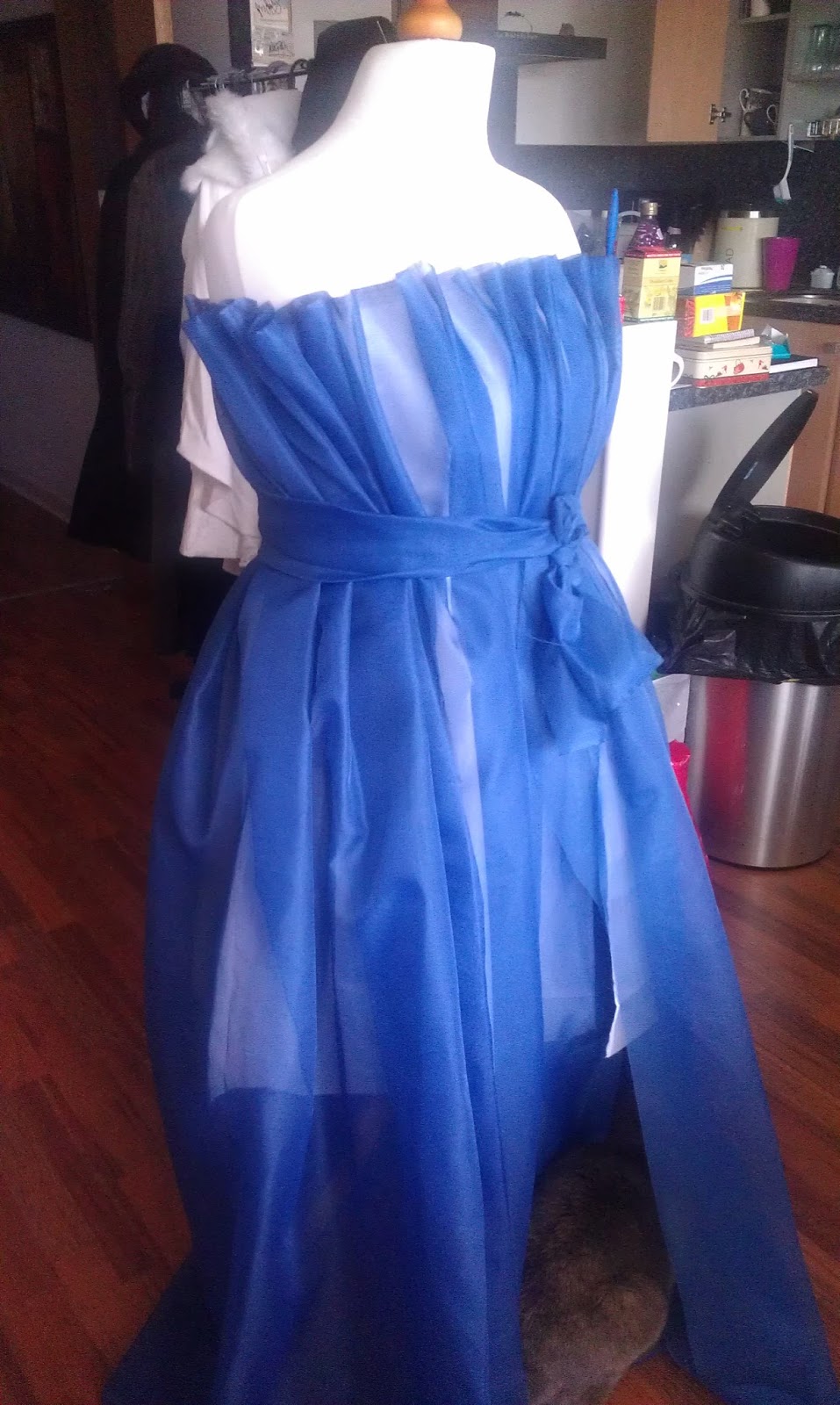
I lay the unpicked blue chiffon over the uncut green to get a basic idea of how much fabric I was going to be using (3m) and where the arm wholes were going to be. Then started pinning it to the mannequin. The easiest way to get the folds to look right was to stick a pin at the beginning of a section (eg, at the front of the arm whole) and at the end of a section (eg, the back of the arm whole), then a pin in the middle of the excess fabric, so you have two large loops of extra fabric. Keep halving the sections until you're happy with it, and can easily gather it. I realised very early on that most of this dress was going to have to be hand gathered. I worked my way around the dress pinning it into place until I thought it looked good, and tied a ribbon around the waist just to see if it sat right.


Then hand gather the chiffon and secure it to the lining. I found it easiest to stand and slowly work my way around the mannequin unpinning little sections then gathering them with thick black thread (so it would be easy to see and remove later. At the end of every section I pulled the thread taught and tacked the chiffon to the lining so that it didn't all fall off when it tried to take it off the mannequin.

The Waist
Next, the waist. The green ribbon marks the waist line, so I took a fabric pen and marked underneath the ribbon, removed it, and then gathered the fabric until it was taught against the lining.


The Neckline
 The neckline was the same principle again. I cut a long strip of fabric which was the length of the front, back and around the arms, then that length was doubled so that it could be gathered. It was cut 2 inches wider than it had to be, and an inch folded over on both sides all the way along the fabric piece (so you have one long strip with an inch tube at the top and bottom. I pinned the open ends at the front and kept halving the material until it sat correctly, then hand gathered it in place, with the gathering going along the stitching of the tubes.


However, once I tried it on I discovered that the gathering over the arms makes it very difficult to move. I stitched the neckline to the dress along the front and back, then added elastic on the parts that looked like capped sleeves to make movement easier. I stitched the top tube to a piece of netting just to make sure it held all the gathers in place.

The Ruffles
The dress body is 3m of fabric, so to make ruffles on the bottom I needed double that, so 6m of 15cm wide chiffon was overlocked (which was a complete pain in the ass, as it gathered the chiffon slightly) and then hand gathered (I tried repeatedly to machine gather and it just didn't seem to work) to the right length. Then I pinned it to the dress. The whole process took 4 hours (mostly because I had to regather half the ruffles because I got a knot in the thread.

Almost finished. Just the buttons and sleeves to do! So far it's looking good.


UPDATE. In a mad rush for an event 2 summers ago I finished the dress, wore it, and immediately sold it. PREPARE FOR EMBARASSING PHOTOS

As much as I enjoyed making this I'm incredibly uncomfortable with the colour. I was encouraged to buy it by someone else and only when I finally put it on did I discover it doesn't suit me at all. I also was a lot larger then and did an ABSOLUTELY hash job at co-ordinating it, as I realised I had nothing to go with it. However, I thought you should see the finished dress.


Thursday, 13 June 2013

DIY Lolita dress: The Blue dress

I would like to be very clear that I take no credit for the design, and this was more an exercise in me getting to use my mannequin for the first time (kindly now dubbed Shirley - I have no idea why).

I first came across this dress a few months ago, and absolutely adored it, but knew there was no way I would fit into it. While it says it's free size, that's free size in Japanese sizes, so I'm already dubious, and when it states that the maximum waist size is 100cm I know I'm out (my waist will fit, but my bust is 112, and there's no way there's an extra 12cm in the bust. For anyone who's wishing to purchase the original dress, it is available in a wide range of colours from Krad Lanrete's shop on Taobao.


Now this is the first dress I have ever made without a pattern, so I started off by decontructing the dress in my head. I noted that it's a button up dress, lined, gathered at the bust (and probably the waist too, but more likely shirred), with ruffling detail around the collar and ends. So I figured I'd start with lining and basically pin it to the mannequin to make it fit. I put my petticoat on the manniquin so I could see if I would be getting the right kind of poof.


I ended up with 4 parts to the lining. Two front, one back with a triangular panel added at the back so the skirt part poofed out more. Now I was happy with how the lining was shaped while pinned, it was time to stitch the it together.

Now for the chiffon. I started basically the same way as I did the lining, only this time I added 3x as much fabric as I had for the lining on the front and back, and 1.5x the amount on the sides. Once it was pinned, I trimmed the lenth, tryking to make it slightly longer than the lining (and failing). At this point came the boring work: gathering. I painstakingly hand gathered each part (working front right, underarm right, etc around the body). I started noticing that I really wasn't happy with the fabric. It had the same see-through properties of the dress I'd been inspired by, but didn't seem to hang right. I took a good 15 minutes to correct all the folds in the second image. I hoped when I added more to the dress it would begin coming into place and sitting right.


.

Next for the collar. I pinned in place a tube of chiffon fabric (turned right side out), and gathered the collar in too places, about 2cm from each edge to create the ruffled look, then added some navy braid to hide any wonky stitching. I then added the button up part (interfaced) and tried the dress on. At the moment I really don't like this dress. I like the idea and the style, but after putting it on (and hurray! It fits!) I feel a bit like I'm in a costume for Violet Beauregard just after she eats the blueberry gum in Charlie and the Chocolate Factory. I figure with a corset or waspie or something that defines the waist (more than just the sash) it would look better, but I think a big problem is the fabric. I'm going to go on a hunt for better chiffon and see what I can find.


Rectangle skirt

A quick tutorial on how to make your own rectangle skirt. A lot of the options are left up to you, and please excuse the crude drawings.

First thing you need is a pattern.


Now, to tell you what that means. Here you have 3 rectangles of different sizes. The first rectangle should be a long, where a is pretty much as long as you like. This determines how much poof your skirt has. It can be anywhere for your hip size (and smaller and it wont fit) upwards, +2cm for seam allowance. I personally like to go for 2-3x waist size, so about 2m of fabric will do. b is the lenth of the skirt, again up to you. I personally like about 50cm.

The second rectangle is your waist band. c should be twice the width you want the waist band to be (I like 3cm) plus 1cm each side for seam allowance. d has a few more options. If you're going to have the skirt zip, then d should be your waist size (plus 2cm for seam). If you are going to have the waist band elasticated make d your hip size +5cm (2cm for seam and 3cm for ease), then cut elastic the size of your waist -2cm or so for a snug fit. If you're going to be fancy and have the waist band PART shirred or elasticated, make d the maximum size you want the waist to be and add 2cm seam for the zip.

The third rectangle is the ruffle. You can have as many ruffles as you like, and can position them anywhere you like. I like to have one ruffle, placed either right at the edge of the first rectangle or about 10cm up. e should be the width of the ruffle. If you are having it NOT attached to the very edge of the skirt make sure it's LONGER than however far you're placing it up the skirt (ie, if you are having it 10cm up, make sure it is LONGER than 10cm. 15 is probably best +1cm for hem). f is double to triple b, depending on how ruffly you want the ruffle to be. Again this is a very flexible pattern.

After this there is no end to embellishments you can put on. I was originally going to (and may still do) paint sea creatures on this fabric in fabric paint (star fish, coral, sea weed, etc) onto the example skirt below. However you could add embroidery, lace trim or ribbon to anywhere you want on the skirt. This can be used as a plain underskirt, or have a chiffon (or other fabric) layer on top. The options are pretty much limitless. It's all about what you want. 


Here's my example (the turquoise skirt)


Here a was 2.5m (so a little over 2.5x my waist size) and b was 50cm. c, which you can't really see sadly, was 125 cm (just over my hip size), d was 8 cm making it a 3cm elasticated waistband. e was 10cm and position 2cm above the bottom edge of the skirt. f I'm not 100% sure on the length, as I just gathered and gathered, then stitched it on until it fit, however I estimate about 4m. The fabric is a lovely soft turquoise linen blend that is going to be an absolute pain to iron :).